Propeller Fatigue . . . A time-bomb waiting to explode!
It is part of every pre-flight inspection, but how many times do we take a magnifying glass to a propeller to check for cracks? Okay, so that may be a bit of over-kill, but tiny cracks in the propeller surface can occur.
When they do, beware! Tragically, a Piper PA-28-140 pilot and his passenger learned this lesson the hard way. The pilot, who had 160 hours total time, paid with his life!
Within moments after liftoff from the Toughkenemon, Pennsylvania airport, there was a loud metallic-sounding explosion. Oil sprayed all over the windscreen. | | | The passenger later said, "It sounded like someone threw a big chunk of metal in the engine, and the engine cowling opened up like a can of sardines." Again, according to the passenger, the pilot maneuvered the airplane toward an open area bordered by trees. He noted that they were too low to clear the trees. It then burst into flames just as they hit the ground. The passenger escaped the wreckage, but burned his hands in his efforts to assist the pilot. The airplane was examined at the site and with the exception of a propeller blade, all major components were accounted for at the scene. A nearby resident later recovered the broken segment of propeller. The engine 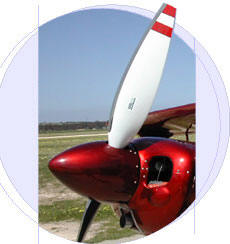 was examined at the Lycoming Engine factory. Examination revealed no pre-impact anomalies or mechanical deficiencies. was examined at the Lycoming Engine factory. Examination revealed no pre-impact anomalies or mechanical deficiencies.
The cause! According to the NTSB Report, the airplane was manufactured in 1972, and had accrued approximately 4,813 total aircraft hours. The airplane's engine had accrued a total of about 4,700 hours of operation and about 475 hours since overhaul.
Examination of the airplane's maintenance records revealed that on April 6, 1995, an entry stated, "Remove paint, remove damage from face of blades, correct angles, dress, track, balance, alodine, and repaint."
A subsequent entry dated May 7, 1998 stated that the propeller was "repitched to 60" following an engine overhaul and conversion. Entries dated July 6, 2001 and July 25, 2002, reflected annual inspections respectively, each included "filed and inspected prop" in the text.
Again, according to the NTSB Report, the propeller and the associated broken segment were examined at the Safety Board Materials Laboratory. Examination revealed that a large portion of the fracture surface displayed crack arrest positions typical of fatigue cracking. The fracture features emanated from an origin area on the camber (forward) surface of the propeller.
NTSB Report click here!
Microscopic examination revealed an area of corrosion around the fatigue origin, as well as sanding scratches and conversion (Alodine) coating. The lesson . . . While rare as far as accident causes, a propeller failure in flight produces devastating consequences. The immediate imbalance caused by the separation of even a small segment of the propeller can produce catastrophic engine failure. The best defense is a careful examination of the propeller(s) prior to beginning any flight. Look for chips, tiny cracks, and even scratches in the propeller surface from tip to hub. If there is any question , don't launch without having it looked at by a trained professional.
The above courtesy of
http://overtheairwaves.com/ | | | | 1 2 3 4 5 6 7 8 9 10 11 12 13 14 15 16 17 18 19 20 Index for this section. | |
| | LightSport Aircraft News. You may link to these pages or print them out for your own personal use.
No part of this publication may be copied or distributed, transmitted, transcribed, stored in a retrieval system, or translated into any human or computer language, in any form or by any means, electronic, mechanical, manual, or otherwise, without the written permission of LightSport Aircraft News. By copying or paraphrasing the intellectual property on this site, you're automatically signing a binding contract and agreeing to be billed $10,000 payable immediately. Copyright LightSport Aircraft News. Email | |
| |