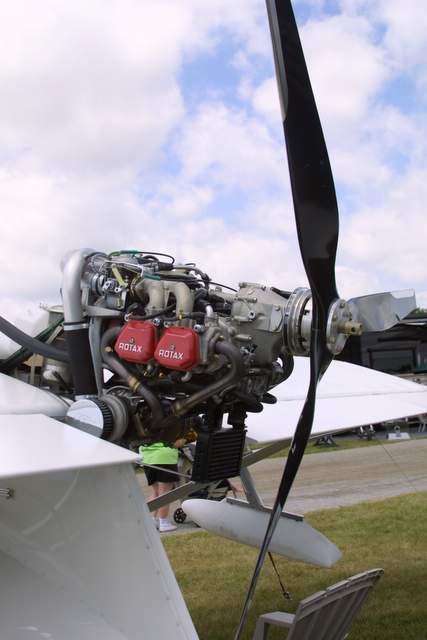
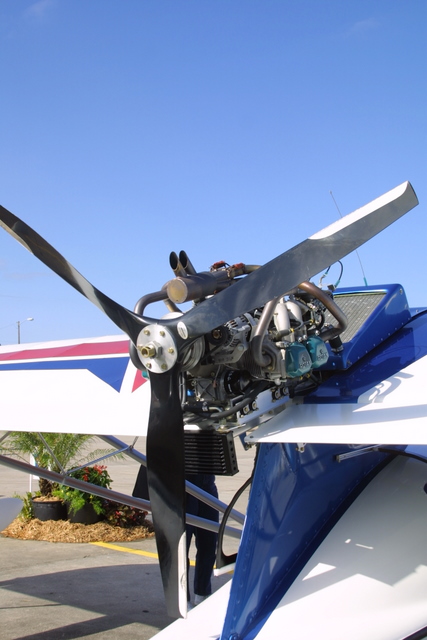
| A heavily loaded plane flying off calm water in hot humid, muggy conditions, are not ingredients for great performance in an underpowered airplane. These conditions provide reduced lift, poor engine performance, and substantially less thrust from a prop than they would at other times of the year. Thus the more power the better! The Rotax 914 engine sits on a very substantial motor mount at the rear of the plane, with the turbo tucked up under the engine. The whole engine is out in the open for easy preflight, but does require a ladder to get up to it. The radiator is hidden in a cowl located at the leading edge of the wing, and the oil cooled is mounted below the engine in front of the turbo charger. Checking the oil is a little tricky as the tank is located in front of the engine, but has to be accessed from the rear of the engine. Changing the oil is made a lot easier by the the addition of a drain valve to the bottom of the oil tank which can be connected to a draining tube. Without this things can get a little messy during an oil change. Oil filter, spark plugs, spark plug caps, coolant level are all easily accessed from the ground or a short step ladder. Ground Handling It will take most pilots a couple of minutes to get use to laying back in the sling style seats, rather than sitting up in the straight back style found in most craft. But after a few minutes it will become very natural and comfortable. The main control systems are very comfortably located. With the throttle sitting in your hand at arms length between the seats. The manual trim is just centrally above your head, and the flap handle in the center section between the seats, at shoulder level, can be reached by either pilot. Throttle response is very smooth, but you have a lot of power above and behind you, in a very heavy aircraft. Power should be applied slowly and gradually until the craft starts to move. Ground Handling is via a steerable tail wheel connected to the rudder cables. The plane reacts well to input BUT does take a little bit of getting use to, as most tail draggers do. Visibility while taxiing is excellent as there is nothing blocking your view forward, or to the side, and a pilot can stick his head out to view rearward. The cable operated brakes drum brakes are engaged via a brake lever on the pilots joy stick. These are effective up to a point. That is they will slow you down and stop you, just not as quickly as some might want. Pilots will find that they do not work if the plane has just come out of the water or is just going back in from coming out. The tailwheel steering system on the SeaRey is a very strong and reliable unit, especially when you take into consideration that unlike land planes where the gear is fixed, the tail wheel has to retract and isn't able to take advantage of using main fuselage components for additional strength. An added feature is that it is able to rotate around 180 degrees, which allows the SeaRey to be be pushed or pulled backwards for easy of parking etc. However pilots should be made aware that the SeaRey does not like to be pushed or pulled backwards abruptly! This can result in the tail wheel retract cable breaking! The main gear suspension for the plane is provided by the two very hefty steel landing gear tubes, and tires. The plane has a very wide stance. This and the heavier weight of the craft make it a plane that is very stable to taxi on the ground. With no tendency to lift it's wings, or tail. |