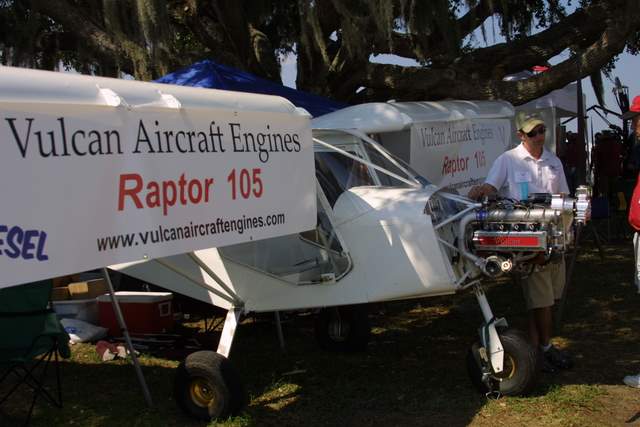
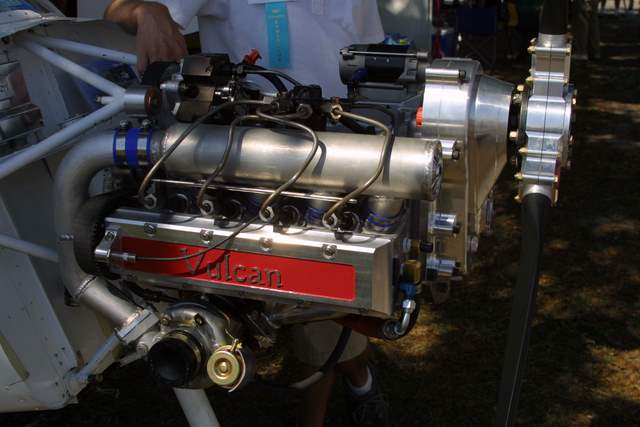
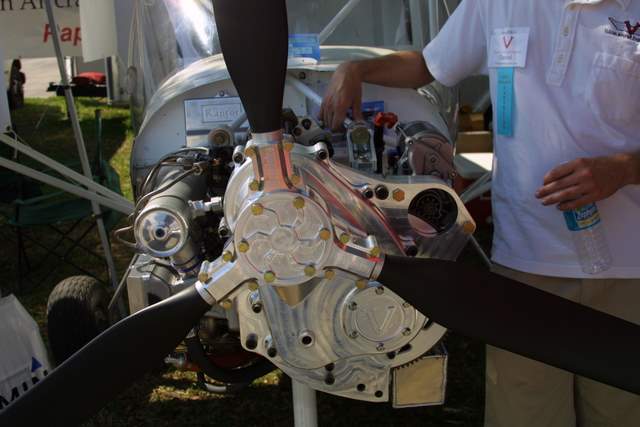
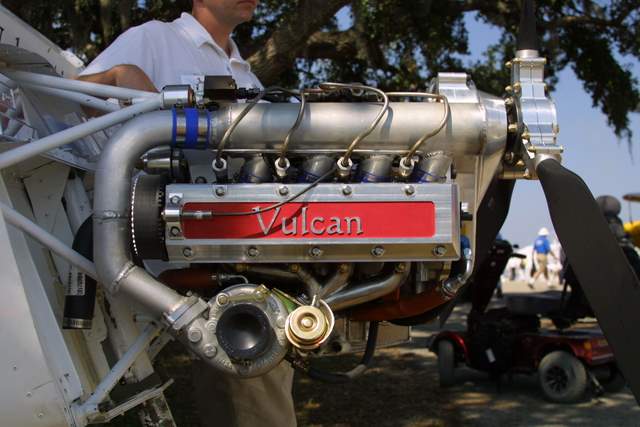
| Vulcan Aircraft engines introduced their Raptor 105 diesel aircraft engine prototype at the Sebring Aviation Expo in January of 2007. At that time the engine did not have all of it's flight ready components attached to it, and consisted of only the long block at cylinder head. At Sun N Fun the engine on display had been run on the dyno, broken in, and was flight ready. The Raptor 105 has been designed specifically to complete with the Rotax 912 series of engines. To accomplish this the factory has made the engine dimensions nearly identical to the Rotax 912's. They have also positioned the prop shaft output to be at the same height. According to Kevin Sweeny of Vulcan Aircraft they have developed the engine specifically for LSA kit plane manufacturers, but the interest from the Sebring show, and Sun N Fun has also made them aware of another market, that of the experimental aircraft kit builder and manufacturer. The Vulcan Raptor 105 is a four cylinder, 92 cubic inch inline engine, laid on it's side putting out 105 turbochared diesel horsepower. Which is flat rated to 10,000 feet. While the engine has a 31 to 27 reduction ratio, (which is 1 to 1.15) it is used not so much as a reduction drive as to position the prop shaft up off the center line of the engine to make it fit in where a 912 engine would normally be used. The engine uses a standard cantilevered style aircraft engine mount, The engine is liquid cooled and currently is being cooled by a standard Rotax radiator. The oil system is wet sump, like you would find on your standard automobile, and has provision for an oil cooler, although testing so far as not required one. Electrical power is supplied by a belt driven alternator, and is available several sizes depending on the electrical draw required. Glow plugs are used for starting the engine, and because it is diesel no ignition system is required. The fuel injection system does require a return line to the fuel tank, and on some aircraft with lower fuel tanks an additional boost pump may be required. As of this writing May 07, the engine has just under 100 hours on the dyno. It has been installed on a Zenair 701 and will begin flight testing later this month. Delivery to OEM customers will begin in June 2007, with the expectation of those engines to be flying on aircraft at Airventure. Kevin indicates that the engine weights in at 179 lbs and they intend to be very competitive with Rotax 912 pricing. |